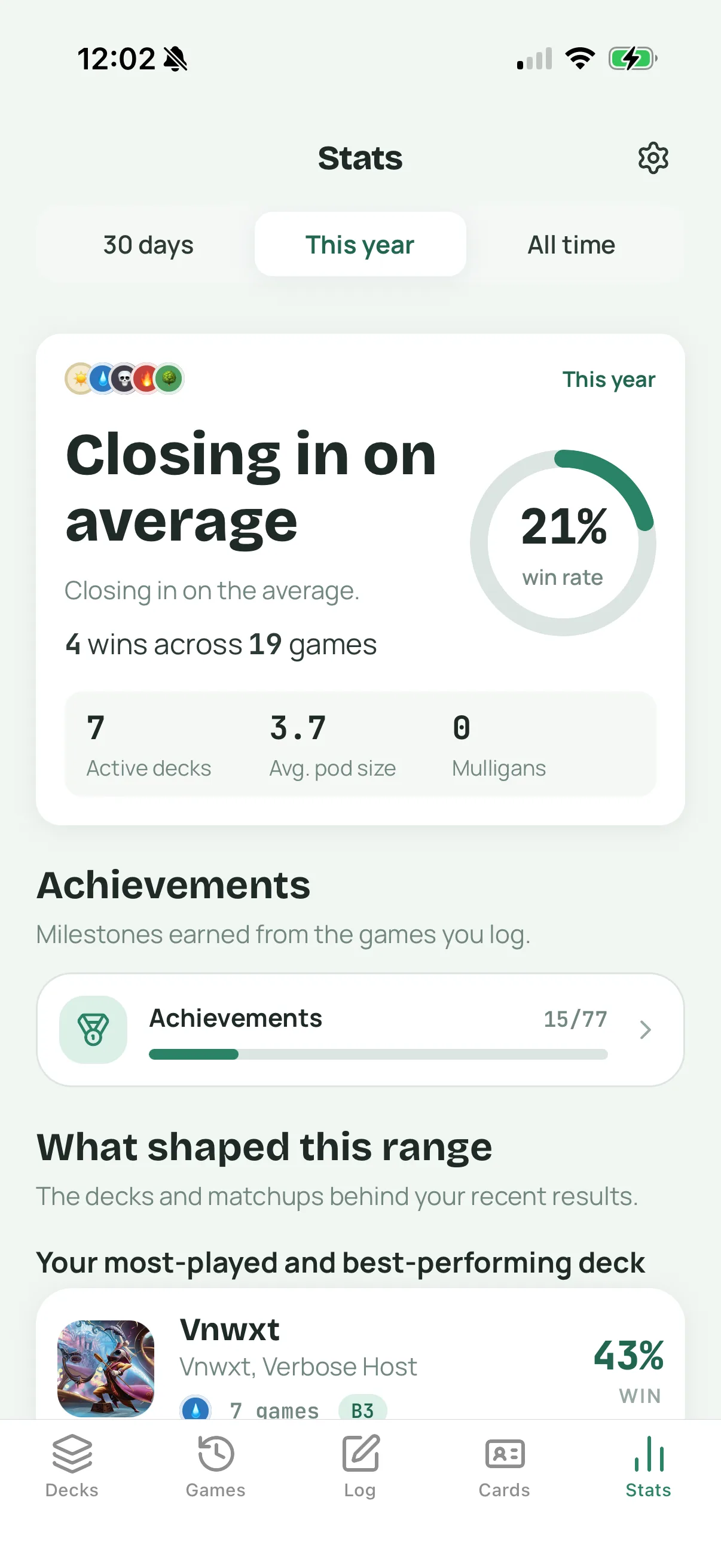
A Commander deck is improving when it does its intended job more reliably at the power level you want. Win rate matters, but it is a lagging signal shaped by three opponents. Faster setup, fewer non-games, better card access, and cleaner closing turns can show improvement before the record does.
Define “better” for this deck
Write one sentence before touching the list: “This deck wants to create creature tokens, protect them, and win through combat around turns eight to ten,” or “This deck wants to control the board and finish with a compact graveyard loop.” That definition prevents an upgrade from making the list stronger but less like the deck you wanted to play.
Also define the target table. Improving a precon for an upgraded-precon pod is different from pushing it toward high power. If the revised deck wins far more but creates worse games for everyone, it may have overshot rather than improved.
Establish a baseline before swapping cards
Log the current version for roughly 15–20 games if practical. Record wins, pod size, turn count, opponents, mulligans, and short issue tags. You are looking for repeat failures, not isolated bad luck: missed land drops, cards stranded in hand, insufficient interaction, or a strong engine that cannot actually end the game.
A smaller baseline can still guide you, but label it honestly. Four losses do not prove a deck is broken, and four wins do not prove the mana base works.
Change a focused group of cards
Make the smallest set of swaps that tests one idea. If the deck misses land drops, adjust lands, cheap draw, or selection—do not simultaneously replace the removal suite and win condition. Save the new list as a version with a short note explaining the hypothesis.
WUBRG’s deck version history keeps each swap beside that version’s results. This makes “the deck feels smoother now” testable: compare the pre-change games with the post-change games while preserving the full story of the list.
Measure consistency, not just wins
| Signal | Improvement looks like |
|---|---|
| Opening hands | Fewer forced mulligans and more hands with mana plus an early play |
| Mana | Fewer missed drops, fewer unusable colors, and less flood without action |
| Game plan | The deck establishes its intended engine in more games |
| Interaction | Answers are available at the turns and for the threats that matter |
| Recovery | A board wipe or key removal spell no longer ends meaningful participation |
| Closing | Winning positions convert into wins with fewer dead turns |
| Win rate | A sustained shift across comparable games, shown with sample size |
Keep the comparison fair
Compare versions against similar pod sizes and power environments. A version tested against precons should not be declared superior to one mostly played against tuned combo. Watch for pilot learning too: you may improve because you learned mulligan choices and threat timing, even if the 99 barely changed. That is still progress, but it is not evidence that every new card was better.
Read losses without overreacting
After each loss, ask what decision the deck failed to support. Did it lack mana, relevant interaction, card access, resilience, or a closer? “Opponent drew perfectly” may be true, but it rarely suggests a useful deck change. Only act when the same failure repeats.
Likewise, inspect wins. A deck can win despite keeping a poor hand or drawing several dead cards because the table fought itself. Record quality and outcome are related, but they are not identical.
A simple improvement cycle
- State the deck’s plan and target power level.
- Log a baseline version.
- Identify one repeated failure.
- Make a small, documented set of swaps.
- Play the revised version against comparable pods.
- Compare consistency signals and results.
- Keep, revise, or revert the change.
Deck-improvement FAQ
How many games should I play before changing my Commander deck?
Unless a card is obviously illegal or nonfunctional, aim for at least 10 games before a broad judgment and closer to 20 for a useful early baseline. Make urgent mana fixes sooner when repeated goldfish hands confirm the issue.
Does a higher win rate always mean the deck is better?
No. Pod strength, sample size, player improvement, and luck all affect win rate. A higher rate is strongest evidence when versions faced comparable games and the deck also became more consistent.
How many cards should I change at once?
Change the smallest focused package that tests your hypothesis—often two to five cards. Large overhauls are sometimes necessary, but they make it harder to identify which choice helped.