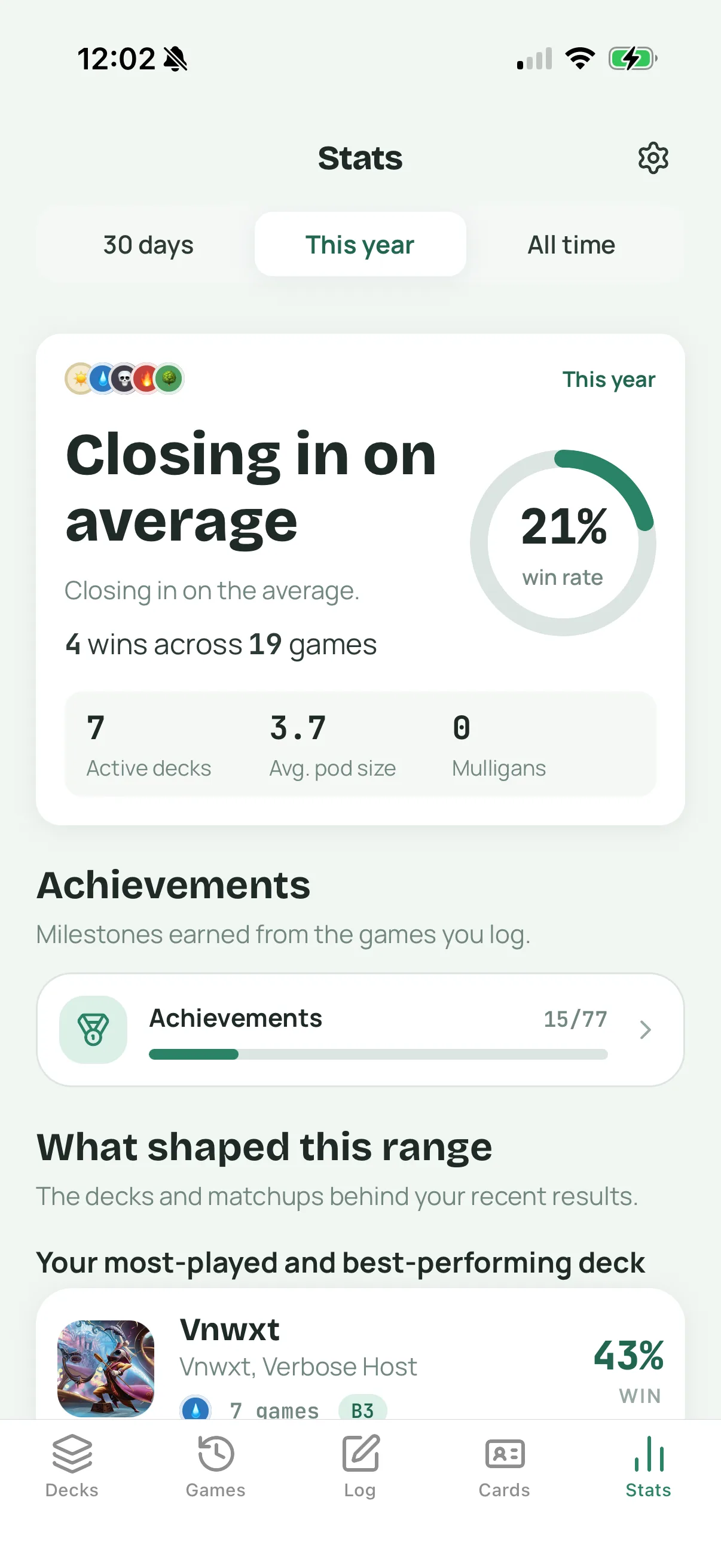
The best Commander statistics to track are the ones that answer a question after the game. Begin with total games, wins, win rate, deck used, pod size, starting seat, opposing commanders, and total turns. Add deck version and one short diagnostic tag if you actively tune lists.
The essential Commander stats
| Statistic | What it tells you | Decision it supports |
|---|---|---|
| Games played | How much evidence you have | Whether a win-rate change deserves attention |
| Wins and win rate | How often player or deck closes | Power-level and performance checks |
| Deck / commander | Which list produced the result | Deck comparison and tuning |
| Pod size | The correct fair-share baseline | Separating 3-, 4-, and 5-player records |
| Starting seat | Position around the table | Testing turn-order assumptions |
| Total turns | Game pace | Matching interaction and curve to your meta |
| Opposing decks | Matchup context | Finding repeated weak or strong matchups |
| Deck version | Which 99 you actually played | Before-and-after upgrade comparisons |
1. Games, wins, and win rate
Always show win rate beside the underlying record. “40%” sounds decisive; “2 wins in 5 games” reveals how unstable it is. For four-player games, 25% is the equal-share baseline when players are evenly matched. Use different baselines for different pod sizes and keep draws visible.
2. Deck and commander performance
Player-wide statistics can hide that one deck earns most of the wins while another rarely executes its plan. Track each deck separately. If you rebuild a list substantially, preserve the same deck identity but create a new version so long-term history and current performance can both be read honestly.
3. Pod size and matchup
Pod size changes both the expected win rate and the number of threats a deck must answer. Opposing commanders provide another useful layer: repeated losses to graveyard, go-wide, or fast-combo strategies may reveal a structural gap. Avoid judging a “matchup” after one memorable game; look for patterns across multiple opponents and nights.
4. Starting seat and game length
Seat data tests whether turn order affects your group. Total turns describe the pace more consistently than elapsed minutes, which include food, rules questions, and conversation. A deck built to stabilize on turn eight will struggle in a pod whose games routinely end on turn six, even if its card quality is high.
5. Deck version and change notes
Version history is the difference between tracking results and learning from them. Record the date and cards changed, then collect a meaningful block of games before evaluating. WUBRG is designed around this workflow: deck swaps stay attached to version performance rather than disappearing into a current list with no history.
Optional stats worth tracking
- Mulligan count: useful when diagnosing land count, curve, or narrow opening hands.
- Elimination order: reveals survival and threat perception when win/loss is too blunt.
- Win condition: shows which closer actually ends games and which one merely looks powerful.
- Mana issue tag: “screw,” “flood,” or “color” can expose a mana-base problem without recording every draw.
- Fun rating: useful for playgroups, provided everyone defines and records it consistently.
Stats that often create more work than insight
Damage dealt, cards drawn, removal spells cast, and commander casts can be fun, but manual tracking changes how people experience the game. Keep a stat only when someone can name the decision it will influence. If the answer is “the chart might look cool,” it belongs in the optional tier.
Start with the core fields in our free Commander game log template. After ten games, add one field that answers a recurring question. A sustainable log with eight columns is more valuable than a perfect 30-column sheet everyone abandons after game two.
Commander statistics FAQ
What is the most important Commander statistic?
Games played is the foundation because every rate needs a sample size. Pair it with wins and deck identity to get the most useful basic record.
Is ELO useful for Commander?
It can be entertaining for a stable competitive group, but free-for-all multiplayer, changing decks, politics, and uneven pod composition complicate a single skill rating. Keep raw records visible beside any ranking.
Should casual groups track stats?
Yes, if the goal is shared curiosity rather than policing play. Stats can spot power mismatches, celebrate deck stories, and improve games without turning the pod into a league.