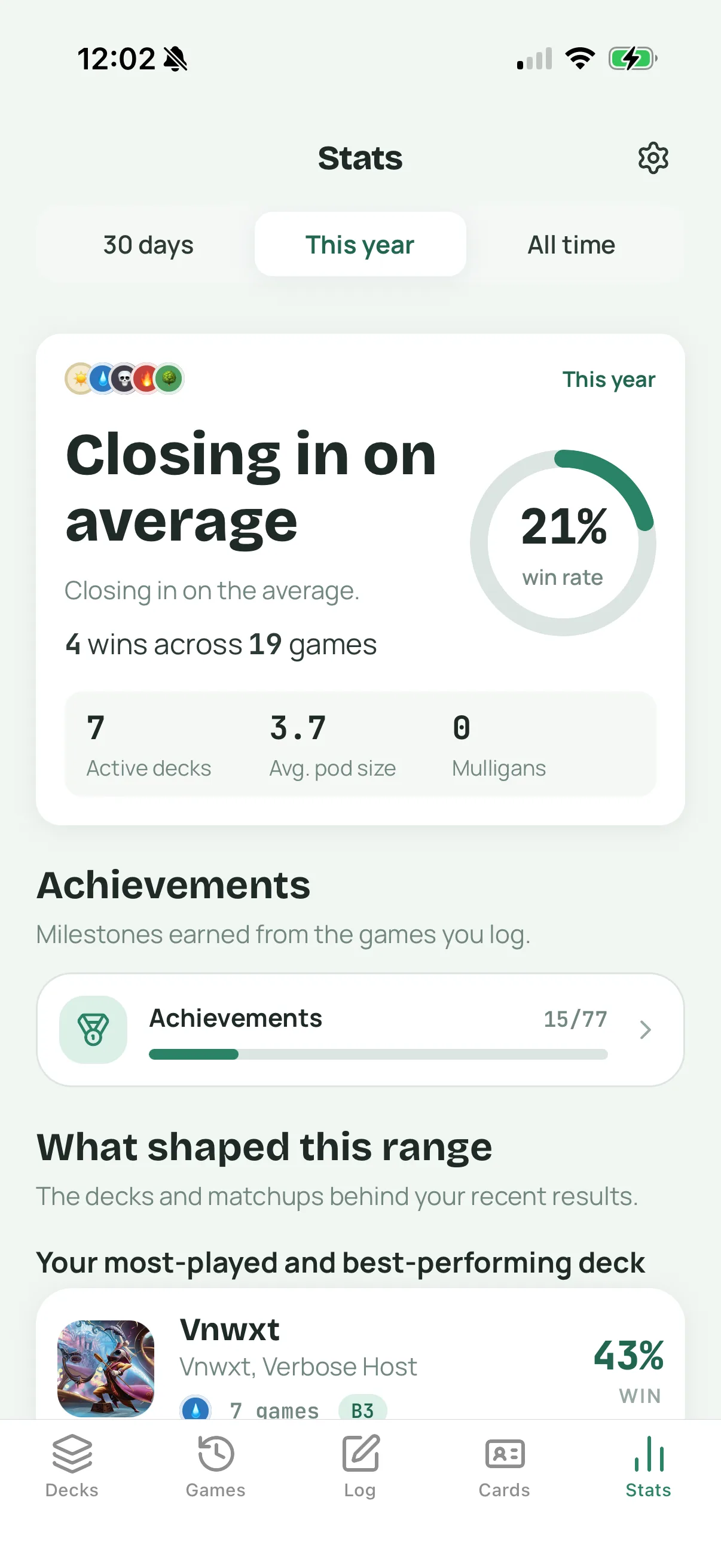
To track Commander matchups, log your deck, every opposing commander or deck, result, pod size, and a small set of strategy tags after each game. Review patterns by archetype before individual commander. Multiplayer results are interconnected, so “0–2 against Muldrotha” is not proof of a bad matchup.
Record one row of consistent context
| Field | Why it matters |
|---|---|
| Your deck and version | Separates current construction from old results |
| All opposing commanders | Preserves the full pod, not only the winner |
| Strategy tags | Groups related decks into analyzable patterns |
| Pod size and environment | Prevents unlike baselines from being combined |
| Winner and win condition | Shows what actually closed the game |
| Final turn | Indicates whether an answer was needed early or late |
Use stable strategy tags
Commander names are precise but often too fragmented. Tag each deck with one primary plan—graveyard, artifacts, enchantress, go-wide, Voltron, control, spellslinger, lands, group slug, or combo—and optionally one secondary tag. Define the vocabulary once. If “tokens,” “go wide,” and “creature swarm” mean the same thing, choose one label so filters do not split the evidence.
Choose the correct unit of analysis
A four-player game creates three opposing relationships, but it is still one game. Do not count it as three games when calculating total win rate. Instead, ask how your deck performs in pods containing at least one graveyard strategy, or how often graveyard decks win when present.
Presence is not causation. A strategy appearing in many losses may be common in the group rather than uniquely strong against your deck.
Look for mechanisms, not grudges
When a pattern repeats, name the failure. Did you lack early interaction, graveyard exile, a way through tokens, protection from wipes, or the ability to pressure a value engine? A mechanism suggests a focused change. “I always lose to Alex” combines player skill, deck choice, targeting, and memory into a claim that is hard to use.
Set a responsible sample threshold
Treat fewer than five relevant games as observations, not a verdict. Ten or more comparable games can reveal an early pattern; larger samples are better, especially when several players pilot the archetype. Display the record beside the percentage and separate major deck revisions.
Test one response
Make the smallest change that addresses the repeated mechanism—two flexible exile effects, faster interaction, or a resilient recovery piece—then save a new deck version. Compare the same matchup tag after another block of games. WUBRG connects opposing commanders and game results, reducing the manual work between logging the pod and reviewing the pattern.
Commander matchup FAQ
What counts as a matchup in multiplayer Commander?
Treat the full pod as one game, then mark which opposing decks or archetypes were present. A matchup is contextual, not an isolated one-versus-one pairing.
Should I track commanders or archetypes?
Track both. Commander names preserve detail; stable archetype tags combine similar strategies into samples large enough to inspect.
When should matchup data change my deck?
When a repeated failure mechanism appears across comparable games and a focused change would remain useful elsewhere. Avoid narrow hate for one memorable loss.